
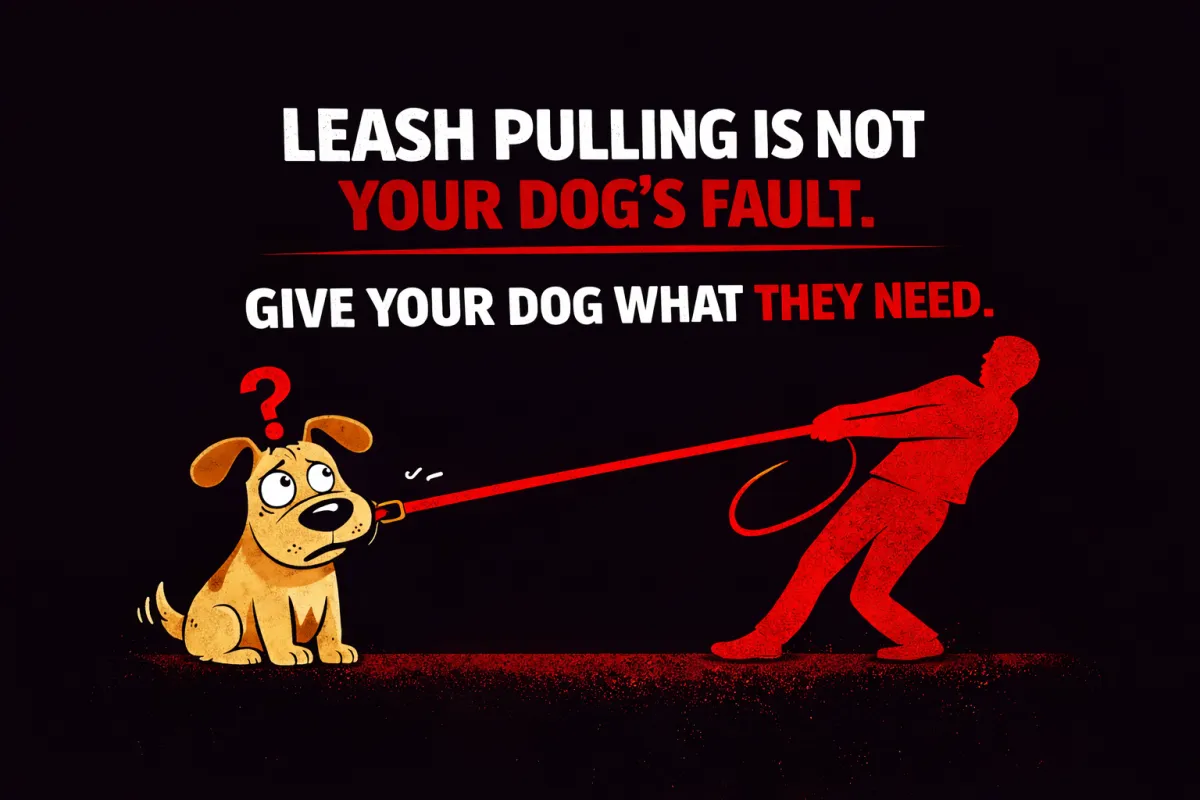
Why Your Dog Pulls on the Leash — It’s an Unfinished Sequence
Leash pulling is one of the biggest problems dog owners deal with, especially in the city like Boston. It’s frustrating, exhausting, and for a lot of people it makes walks something they don’t even enjoy anymore.
But the first thing you need to understand is this: leash pulling is not the real problem.
Your dog is not trying to be difficult. Your dog is trying to do something important.
After spending most of the day inside, bored, disconnected from real life, your dog goes outside and finally has a chance to do what they are built to do. They want to move, explore, smell, chase, and engage with the environment. So they rush. They pull. They try to use that short window of time to meet those needs.
Most people see that and think, “My dog has a leash pulling problem.”
No.
Your dog has a need.
Think about it honestly. We ask dogs to stay home like humans. Don’t bark, don’t chew, don’t run, don’t do anything. Then we go outside and we say don’t pull, don’t sniff, don’t react, just walk next to me.
So when is your dog allowed to be a dog?
That’s the real question most people never answer.
When was the last time your dog ran freely? Not walked, but actually ran. When was the last time your dog chased something, explored something interesting, or felt fully engaged with the world? Not the same streets, not the same routine, not the same boring walk around your neighborhood in Weymouth or Boston. Real experience.
This is where most leash pulling and dog behavior problems actually come from.
Dogs are not struggling because they don’t understand how to walk. They are struggling because they are trying to start something they are never allowed to finish.
Your dog starts a sequence. They sniff, they follow, they get interested, they want to chase. And right there… we stop it.
The sequence never ends.
So the energy stays inside. That’s why next time they go outside, they pull even harder. They are not being stubborn. They are trying to complete something that was never completed before.
If you think about it, this is exactly how dogs are built to live.
A wolf wakes up, starts searching, finds a trail, follows it, sees a rabbit, chases it, catches it, fights it, eats it, and then goes to sleep.
That’s a complete sequence.
Your dog needs the same thing.
Not the rabbit, but the process.
Your dog goes out with you. They search, they move, they chase through play, they catch the toy, they fight in tug, and at the end… you feed them.
That’s the finish.
That’s the end of the sequence.
And after that, your dog is ready to rest.
That’s what creates calm. That’s what creates balance.
Now, how do you actually do this in real life?
You don’t need anything complicated.
You just need to match your play to the sequence.
Start with sniffing. Let your dog use their nose. You can hide food or a toy in the grass and let them search. That replaces the “finding the trail” part.
Then create movement. Use a flirt pole, a ball, or even just run with your dog so they can chase. That replaces the chase.
Then let them catch something. A ball, a frisbee, a toy. Let them win. That’s important. That replaces the catch.
After that, play tug. Let them engage, bite, and fight in a controlled way. That replaces the fight.
And then you end it. No endless play. No chaos.
You finish the game, you calm them down, and then you feed them.
Now the sequence is complete.
Now your dog can rest.
That’s the difference between a tired dog and a fulfilled dog.
Most dogs today are tired… but not fulfilled.
That’s why they still pull, still bark, still react.
They are still in the middle of the sequence.
When you start completing that sequence for your dog, everything changes.
Your dog doesn’t go outside desperate anymore. They don’t feel like they have to rush and grab everything at once. They are more balanced, more focused, and easier to work with.
And then leash walking becomes something you can actually teach, not something you’re constantly fighting.
Leash pulling is not something you fix by forcing the dog to stop.
It’s something you solve by understanding the dog first.
If you change the dog’s daily life, and allow them to complete that sequence, the walk will change with it.
If you’re dealing with leash pulling, reactivity, or other dog behavior issues, I offer dog training in Boston and surrounding areas, including Weymouth and the South Shore.
You can book a free 30-minute consultation here:
https://dogtrainingmakessense.com/calendar